The first ten bas-relief carvings you make decide whether you fall in love with the craft or quietly list your router on Marketplace. Most people start with the wrong one. They buy a face, or a landscape, or a portrait of their dog, carve it at a stepover that was a guess, and get something soft and sad. Then they blame the machine.
This is the list we hand to new customers, rebuilt so the order does the teaching. Ten projects, each one a real file from the catalogue, each sized for a Saturday and one piece of stock, each teaching exactly one thing the next one needs. Start at the top. By project ten you will be running an overnight landscape without a second thought, and you will understand why.

The ten, in order
- How to use this list
- 1. A single flower
- 2. A small heart panel
- 3. A single animal portrait
- 4. A wreath
- 5. A coastal scene
- 6. A name sign with one relief element
- 7. A pet piece
- 8. A dark-themed panel
- 9. A face
- 10. A large landscape
- The four-bit kit that covers all ten
- What to do after project ten
- Questions people ask
How to use this list
Every project below gives you the file, the stock, the bits, a carve time, and the one thing it teaches. Three rules make the list work:
- Do them in order. Each one assumes the lesson from the one before. Skipping to the face is how people get the sad result.
- Carve times are for a hobby machine with a roughing pass and a sensible stepover, which our carve-time guide explains. Without a roughing pass, treble them.
- Finish every one. Even the flower. Raw wood is one colour and only shadow gives it shape; the finishing guide is the other half of every project here. The quick version for small pieces: brush the fuzz off, seal, wipe a dark glaze back off the high points, oil.
1. A single flower


File: Blue Magnolia Blossoms Bas-Relief STL for CNC Carving, $5.20
Stock: basswood or poplar offcut, 150 by 100 mm, 3/4 inch.
Bits: 1/4 inch end mill to rough, 2 mm tapered ball to finish.
Time: 30 to 45 minutes.
What it teaches: the whole workflow, start to finish, with nothing that can look "wrong".
Magnolia blossoms are the perfect first carve because petals forgive everything. A slightly coarse stepover reads as texture. A little fuzz brushes off. There are no eyes to line up. Set the finish pass at 12%, let the machine run, and use the time to read the finishing guide. When it is done, brush, oil, and put it on a shelf. You now own a carving and you have learned half of what this craft is.
2. A small heart panel
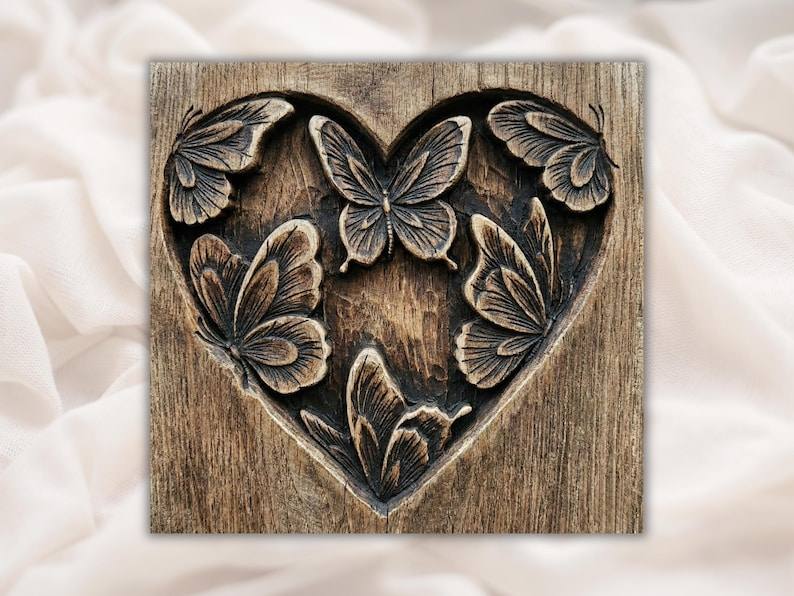
File: Butterfly Heart Bas-Relief STL for CNC, Laser and 3D Print, $5.20
Stock: cherry or walnut, 200 by 200 mm, 3/4 inch.
Bits: 1/4 inch end mill, 2 mm tapered ball.
Time: 45 to 70 minutes.
What it teaches: hardwood, and the difference finishing makes.
Your first hardwood. Cherry and walnut cut cleaner than basswood, hold an edge, and take oil like nothing else. A heart made of butterflies and flowers has enough small elements to show you what a 2 mm bit can and cannot resolve, and it is the first piece on this list somebody will actually want as a gift. It also prints and lasers, which makes it the one you can make on almost anything. Glaze this one; the contrast between the dark ground and the pale butterflies is the lesson.
Download the butterfly heart · $5.20
3. A single animal portrait

File: Howling Wolf and Full Moon Bas-Relief STL for CNC Carving, $7.19
Stock: walnut or maple, 250 by 300 mm, 1 inch.
Bits: 1/4 inch end mill, 1 mm tapered ball.
Time: 1.5 to 2.5 hours.
What it teaches: fur, and why stepover matters.
The wolf is the first project where the bit marks will show if you rush. Fur pushes the finish pass into territory where a 15% stepover reads as corduroy from across the room. Tighten it to 10% on the wolf itself and leave the moon and sky at 15%, using a boundary vector, and you have just learned the single most useful trick in relief carving. Carve the moon in maple if you want it to glow pale against a dark glaze.
Download the howling wolf · $7.19
4. A wreath

File: Royal Stag and Oak Leaf Wreath Bas-Relief STL Carving, $6.39
Stock: cherry, 300 by 300 mm, 1 inch.
Bits: 1/4 inch end mill, 1.5 mm tapered ball.
Time: 2 to 3 hours.
What it teaches: overlapping elements and depth layers.
Leaves crossing under each other, antlers over the leaves, a stag in the middle. A wreath is where you find out that relief depth is layered, not smooth, and that the way the layers read after carving depends on the glaze getting down into the crossings. Slow the feed a little on the finish pass, 3,000 mm/min rather than 4,000, and the crossings stay crisp.
Download the stag and oak wreath · $6.39
5. A coastal scene

File: Lighthouse Harbor Seascape with Sunburst and Fishing Boats STL, $5.20
Stock: walnut or sapele, 350 by 250 mm, 1 inch.
Bits: 1/4 inch end mill, 1 mm tapered ball.
Time: 2.5 to 4 hours.
What it teaches: foreground, middle ground, background.
The first multi-element scene: a lighthouse in front of water in front of sky and a sunburst. This is where relief starts to feel like sculpture rather than decoration, and it is the project that shows you why depth has to scale with width. Crush the Z on a scene like this and the layers stack instead of receding. Keep the file's proportions and it reads from across the room.
Download the lighthouse seascape · $5.20
6. A name sign with one relief element

File: DAD Bass Fishing Sign Bas-Relief STL with Rod and Reel, $6.39
Stock: cherry, 400 by 200 mm, 3/4 inch.
Bits: 60 degree V-bit for the lettering, 1.5 mm tapered ball for the relief.
Time: 1 to 1.5 hours.
What it teaches: two toolpaths on one board, and personalising.
Relief plus V-carved text on the same panel. The relief goes first, the lettering second as its own toolpath, and the two have to share a zero. This is the combination behind almost every commission you will ever be asked for: a name, a date, and something carved beside it. Practise it here on a design that is already a gift. Swap "DAD" for any name in your CAM and you have your first custom order.
Download the fishing sign · $6.39
7. A pet piece

File: Human Hand Cradling a Dog's Paw Bas-Relief STL, $7.19
Stock: cherry or walnut, 300 by 250 mm, 1 inch.
Bits: 1/4 inch end mill, 1 mm tapered ball, 0.5 mm tapered ball for the paw pads.
Time: 3 to 4 hours.
What it teaches: a boundary for the fine bit, and carving something that matters to someone.
A human hand cradling a dog's paw. It is a memorial piece more often than not, and the first project here where the result will be given to someone who is grieving. Carve it with care: the hand at 1 mm, then a boundary around the paw for the 0.5 mm pass so the pads read. Do not attempt a custom photo-to-relief of somebody's actual dog as your first pet piece; carve this designed file first, so you know your machine can do it before you promise anyone anything.
Download the paw memorial · $7.19
8. A dark-themed panel

File: Perched Raven Under a Full Moon Bas-Relief STL, $7.19
Stock: walnut, or cherry with a black glaze, 300 by 400 mm, 1 inch.
Bits: 1/4 inch end mill, 1 mm tapered ball.
Time: 2.5 to 4 hours.
What it teaches: contrast as a design tool.
A raven under a full moon. Gothic pieces are satisfying because the contrast between a pale moon and a near-black bird does most of the work for you, and it is the project where the glaze step stops being a finishing detail and becomes the design. Wipe the moon almost clean; leave the raven and the forest dark. Skip the gloss. A satin or matte topcoat keeps the wood reading dark and moody.
Download the raven and moon · $7.19
9. A face

File: Face of Christ and Crucifixion Bas-Relief STL with Crown of Thorns, $16.00
Stock: cherry, 300 by 450 mm, 1 inch. Not oak.
Bits: 1/4 inch end mill, 1 mm tapered ball, 0.5 mm tapered ball inside a boundary around the face.
Time: 5 to 8 hours.
What it teaches: everything at once.
Faces are the hardest thing in relief carving. Likeness lives in the eyelids and the corners of the mouth, and those are the smallest features on the panel. This is why the face is number nine and not number one. By now you know the boundary trick, you know why the bit has to be smaller than the feature, you know the glaze will give the eyes their shadow, and you know not to carve it in oak. The Face of Christ is the most carved devotional piece we make, and the messages people send after giving one are the reason this list exists.
Download the Face of Christ · $16.00
10. A large landscape

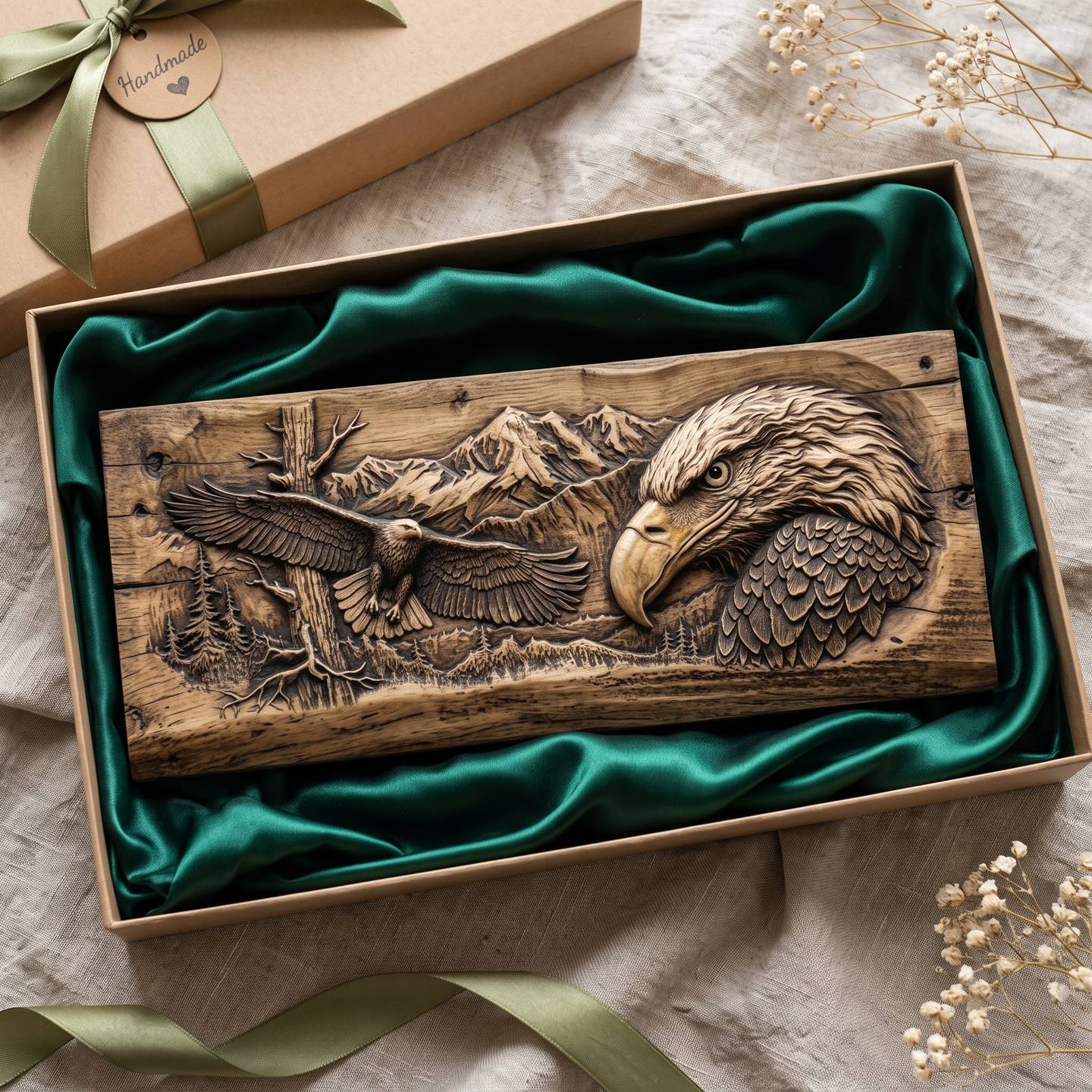
File: Bald Eagle Mountain Scene Bas-Relief STL with Soaring Eagle, $10.39
Stock: walnut or cherry, 500 by 300 mm, 1 inch.
Bits: 1/4 inch end mill, 1/8 inch tapered ball for the semi-finish, 1 mm tapered ball inside a boundary around the eagle.
Time: 4 to 7 hours with the full bit ladder. Overnight without it.
What it teaches: the full three-pass method, and patience.
By project ten you are ready for a multi-pass carve that runs while you sleep. Sky, mountains, trees and a bird at four distinct depths, plus a second eagle in flight. Rough it with the flat cutter, semi-finish everything at 15% with the 1/8 inch, then draw a vector around the eagle's head and wings and run the 1 mm inside it only. Plan the toolpaths carefully and check the zero twice: a 500 mm walnut blank is a serious board, and you do not want to learn at hour six that the origin was wrong.
Download the eagle mountain scene · $10.39
The four-bit kit that covers all ten

You do not need a wall of carbide. You need four cutters, and a spare of each of the small ones so a snapped tip at hour four does not end your weekend:
| Cutter | Job | Rough cost |
|---|---|---|
| 1/4 inch two-flute end mill | Roughing, every project | $15 |
| 2 mm tapered ball nose | Finishing on projects 1 and 2 | $20 |
| 1 mm tapered ball nose | Finishing on projects 3 to 10 | $25 |
| 0.5 mm tapered ball nose | Fine passes on 7, 9 and 10, inside a boundary | $35 |
Add a 60 degree V-bit for project six if you do not already own one. Amana, Whiteside, SpeTool and IDC Woodcraft all make dependable tapered cutters; the cheapest no-name tapered ball noses are a false economy because a dull one leaves fuzz you will spend an hour removing.
What to do after project ten
If you have carved all ten, you are past most people who ever bought a router. Three useful directions from here:
- Sell what you carve. Every file includes commercial use for the physical pieces. The gift guide is a good map of what people actually buy.
- Learn to judge files. What makes a good bas-relief STL will save you from every bad marketplace download for the rest of your life.
- Go bigger and faster. The carve-time guide is the difference between a weekend and an afternoon.
Questions people ask
What is the easiest relief carving for a complete beginner?
A single flower or leaf in basswood. Petals forgive a coarse stepover and there are no faces to get wrong.
Which wood should a beginner use?
Basswood or poplar for the first one, cherry from the second onward. Avoid oak and pine for anything with fine detail.
How long does a beginner carving take?
Under an hour for the first two projects, two to four hours through the middle of the list, and an afternoon or overnight for the final landscape.
What bits do I need to start?
A 1/4 inch end mill and a 2 mm tapered ball nose will do the first two projects. Add a 1 mm and a 0.5 mm tapered ball as you go up the list.
Why is the face so far down the list?
Because likeness lives in the smallest features on the panel and needs every lesson above it: a fine bit inside a boundary, the right wood, depth kept in proportion, and a glaze to give the eyes their shadow.
Do I have to finish them?
Yes. Raw wood is one colour. The glaze-and-oil step is what turns a carving that looks flat off the machine into one that reads across a room, and it is where most of the difference between a beginner and a professional result actually lives.
Ten weekends, one board each, and the order does the teaching. Start with the magnolia. The free starter pack has small designs made for exactly this kind of first weekend if you want to prove your machine before spending anything, and the catalogue has the rest.
One project missed this list only because it is not a wall piece. A valet tray is the first job where the pocket matters more than the picture, and it teaches depth, workholding and tabs in about an hour of machine time. There is a full walkthrough in how to make a CNC valet tray.
Jolly, DigitalChiselCo