Selling What You Carve: Pricing CNC Relief Carvings, What Sells, and What the Licence Allows
Jolly · Sep 5, 2026 · 10 min read
Two questions arrive together, usually about a week after somebody's first good carving comes off the machine: what should I charge for this, and would anyone actually buy it? The answers are yes, more than you think, and more than you were going to charge.
This guide is the practical version: a pricing formula that survives contact with a craft fair table, the numbers behind it, what sells (from our own sales data, not a hunch), how to photograph and present a panel so it fetches its price, where to sell, and exactly what our licence does and does not allow you to do with the files.
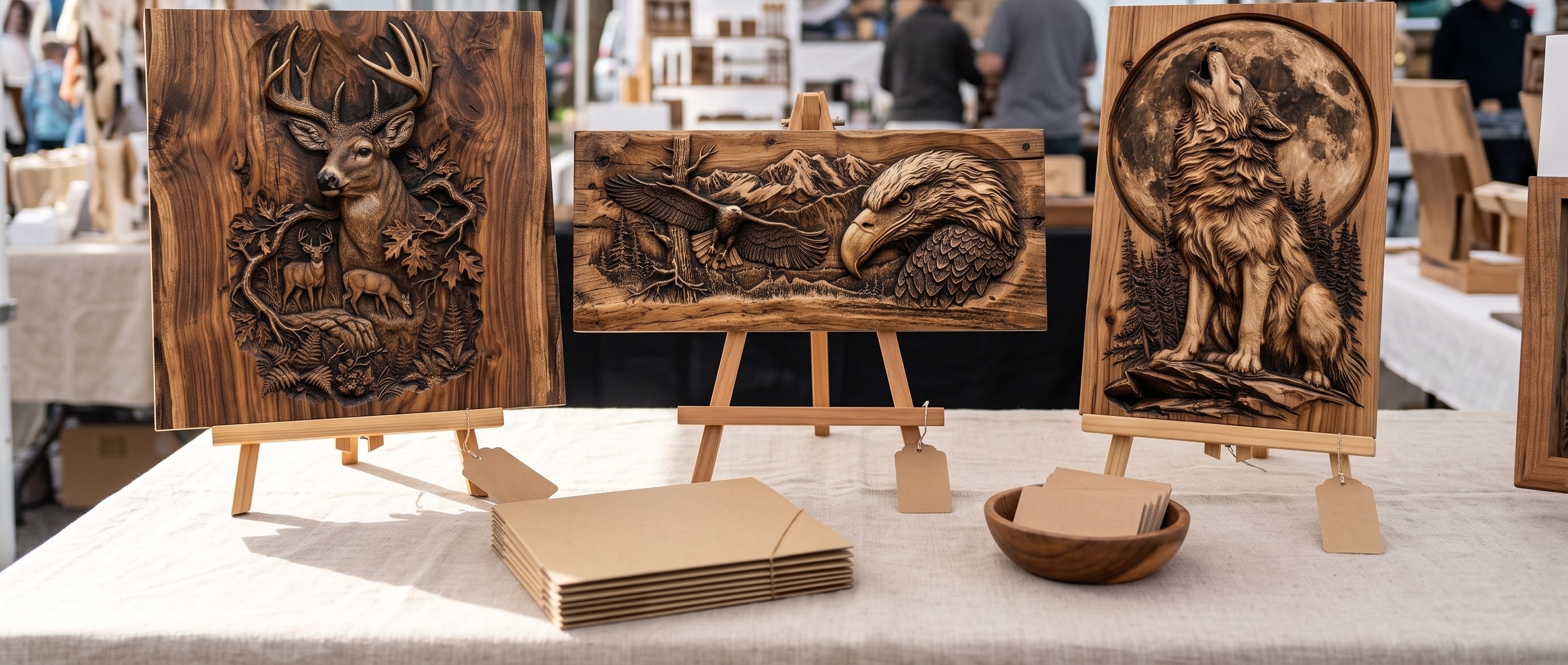
A carved panel on an easel, a linen cloth, a handwritten tag. Presentation is half the price, and it costs almost nothing.
Every file in the catalogue comes with commercial use for the things you make. In plain words, from our terms:
You may carve, print or engrave the design and sell the physical result, in any quantity, at any price, anywhere: craft fairs, your own website, Etsy, a gallery, commissions. No royalties, no per-piece fee, no attribution required.
You may not resell, share, redistribute or sublicense the file itself, or anything that is essentially the file: no selling the STL, no bundling it into a "design pack", no uploading it to a file-sharing site, no passing it to a friend who did not buy it.
That is the whole of it. The distinction is physical versus digital: the wood is yours, the file is licensed. If you are ever unsure whether something counts, ask; the answer is usually yes.
The pricing formula
Most first-time sellers price a carving at the cost of the board plus whatever feels polite, and lose money on every one. The formula that holds up:
Price = (materials + machine time + your time) × 2, then round up to a number that looks deliberate.
Each term, honestly:
Materials. The board, the finish, the hanger, the box. Real numbers, not "I had it lying around". A 400 by 300 mm cherry blank at 1 inch is roughly $25 to $40; walnut nearly double. Finish and packaging add $3 to $6 per piece.
Machine time. Charge for it, because the machine, the cutters and the electricity are real and the cutter is a consumable. $10 to $15 an hour of spindle time is the range small shops use. A well-set-up 400 mm panel runs three to five hours (see the carve-time guide), so $40 to $75.
Your time. Setup, clamping, sanding, sealing, glazing, oiling, waxing, fitting the hanger, photographing. This is two to three hours of actual hands-on work spread over a week of curing, and it is where the value is made. $25 an hour is a floor, not a ceiling.
Times two. The multiplier covers the things nobody writes down: the failed board, the snapped bit, the fair fee, the platform commission, the hour answering questions, and profit. Without it you have a hobby that costs money.
Then round up. $137 looks like arithmetic; $145 looks like a decision. People trust decisions.
Rather than do the arithmetic by hand every time, put your own numbers into the calculator below. The presets match the worked examples in the next section, so you can see where those prices came from and then replace them with your board, your machine and your rate.
Price calculator
The formula above, with your numbers. Change anything and the price updates. Nothing leaves your browser.
Materials
Machine time
Your time
Pricing
MultiplierCovers waste, failed boards, fees and profit
Round up to$145 looks like a decision, $137 like arithmetic
Worked examples with real numbers
Piece
Materials
Machine
Your time
Cost
× 2, rounded
Small heart panel, 200 mm, cherry
$10
1 h · $12
1 h · $25
$47
$95
Wildlife panel, 400 mm, cherry
$35
4 h · $48
2.5 h · $63
$146
$295
Same panel in walnut
$60
4 h · $48
2.5 h · $63
$171
$345
Serving tray, 450 mm, maple, food-safe finish
$40
5 h · $60
2 h · $50
$150
$295
Large landscape, 600 mm, walnut
$95
8 h · $96
4 h · $100
$291
$585
Face or devotional panel, 400 mm, cherry, full finish
$35
6 h · $72
3 h · $75
$182
$365
If those numbers feel high, look at what a framed print of similar size sells for in a furniture shop, then remember that yours is carved from a single board and nobody else has one. The people who baulk at $295 were never going to buy a carving. The people who buy carvings expect it.
Two adjustments. Commissions, where the customer chooses the design and wood, carry a premium of 25 to 50% because the piece cannot be resold if they change their mind, and a deposit of half up front. Repeat designs you have carved before and have the setup for can come down toward cost × 1.7 if you are building volume.
What actually sells
This is from our own data: what people buy files for, which is a fair proxy for what they sell carvings of, since almost everyone buying a relief file intends to carve it more than once. Over the last year, in order:
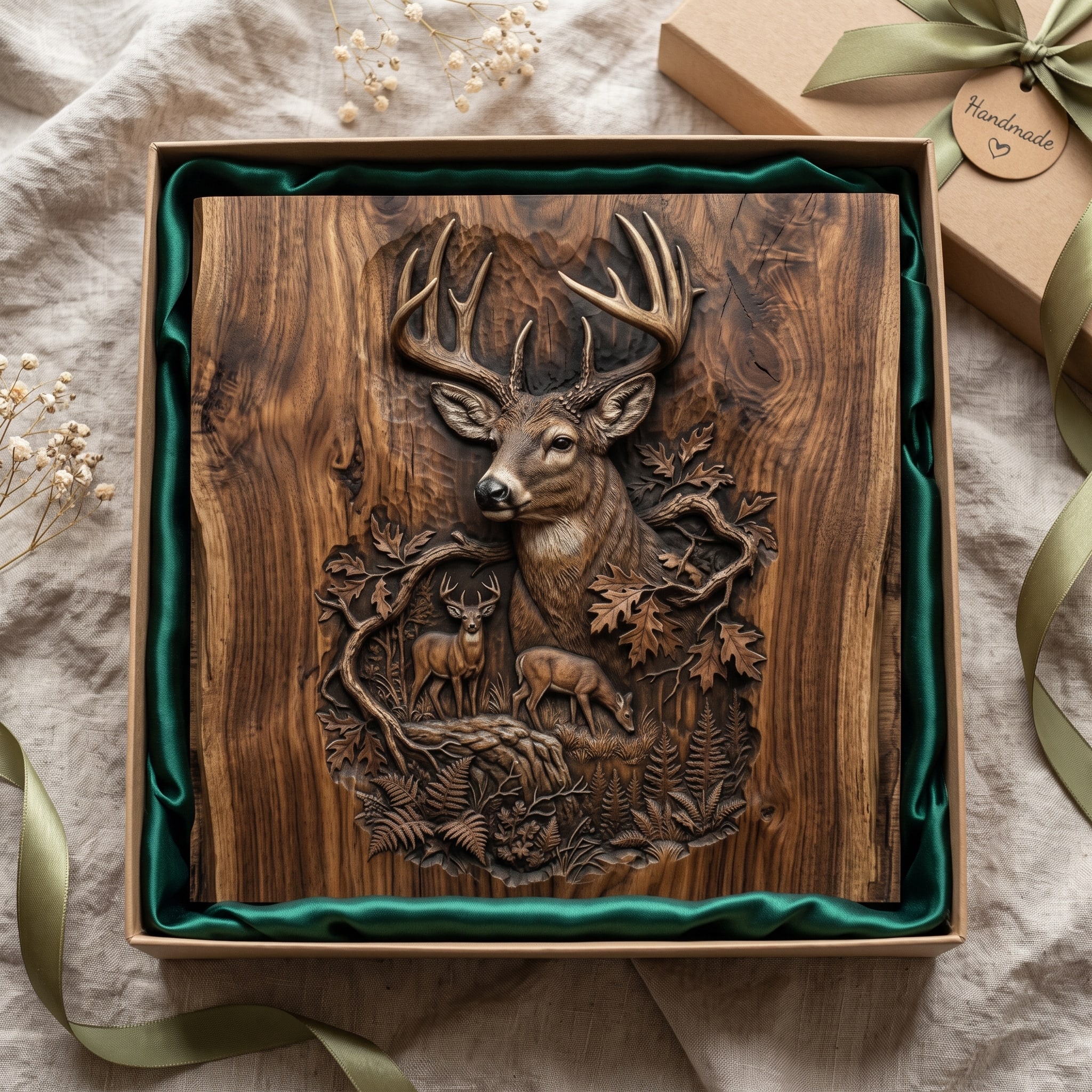
Wildlife with a scene behind it. A buck in the forest, an eagle over mountains, a wolf and a moon. The single biggest category by a wide margin, and the one with the broadest audience: cabins, lodges, garages, offices, gifts for men who are hard to buy for.
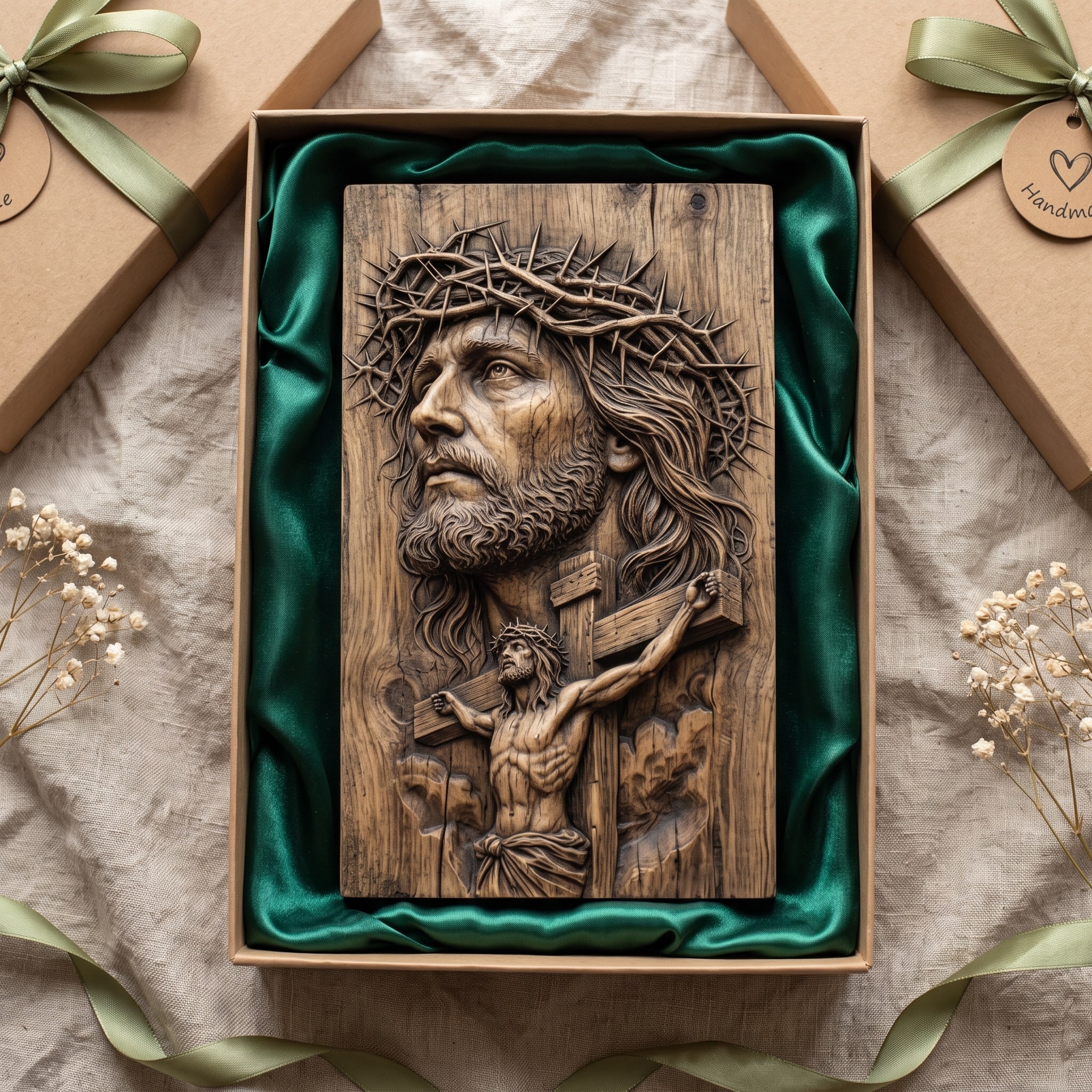
Faith. The Face of Christ, the Last Supper, hands in prayer. Fewer buyers, higher prices, and the strongest emotional response of any category; these are given at confirmations, weddings and funerals, and the buyer rarely negotiates.
Serving trays with compartments. The Highland cow, the octopus, the alligator. They sell because they are used, not hung, and because they photograph beautifully with food in them. Higher material cost, higher price, and repeat customers who come back for a second.
Fishing. Trout, fly reels, river scenes. Fishing is the most searched word on our site all year; anglers already own every gadget and a carving is the thing they do not have.
Pets and memorials. A hand cradling a paw. Lower volume, near-zero price resistance, and the one category where people write to say thank you.
What sells less than sellers expect: abstract and geometric work, and anything that needs explaining. What sells more: anything that says a place, an animal, a faith or a hobby in one glance. The gift guide is organised around exactly that and doubles as a stock list for a fair table.
Photographing a carving so it sells
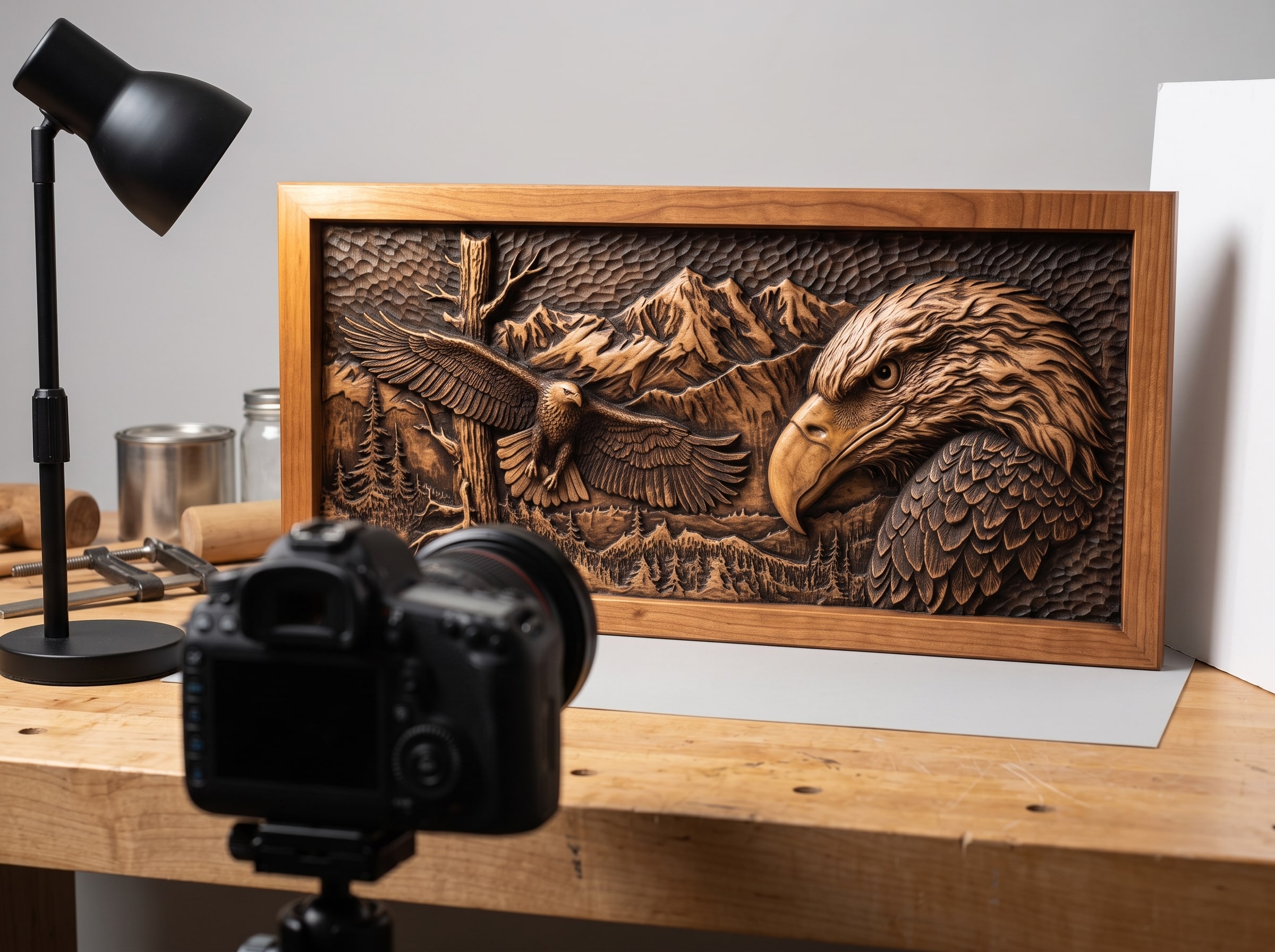
One lamp from the side, a plain background, a white board to bounce a little light back. That is the entire setup behind every photograph on this site.
Relief is shadow, and a photograph lit from the front has none. The buyer is looking at a flat picture of a carving that, in person, has 14 mm of depth; if the picture is flat, so is the price.
One light, from the side, low. A window at 9 am, or a single lamp on a stand, skimming across the panel so every edge throws a shadow. Never the ceiling light, never the camera flash.
A plain background. Grey card, a linen cloth, a bare wall. The carving is the subject; the background is not.
Three shots minimum. Straight on, three-quarter angle to show depth, and one close macro of the best detail, the eye or the feathers. A fourth in situ, on a wall or a table, sells the size.
No filters. Buyers who receive a carving that looks different from the photograph leave the reviews you do not want. Correct the white balance and stop.
Include something for scale in one shot: a hand, a mug, a chair. A carving that looks 20 cm in the photograph and arrives 45 cm wide is a happy surprise; the reverse is a return.
Packaging, hanging hardware and the card
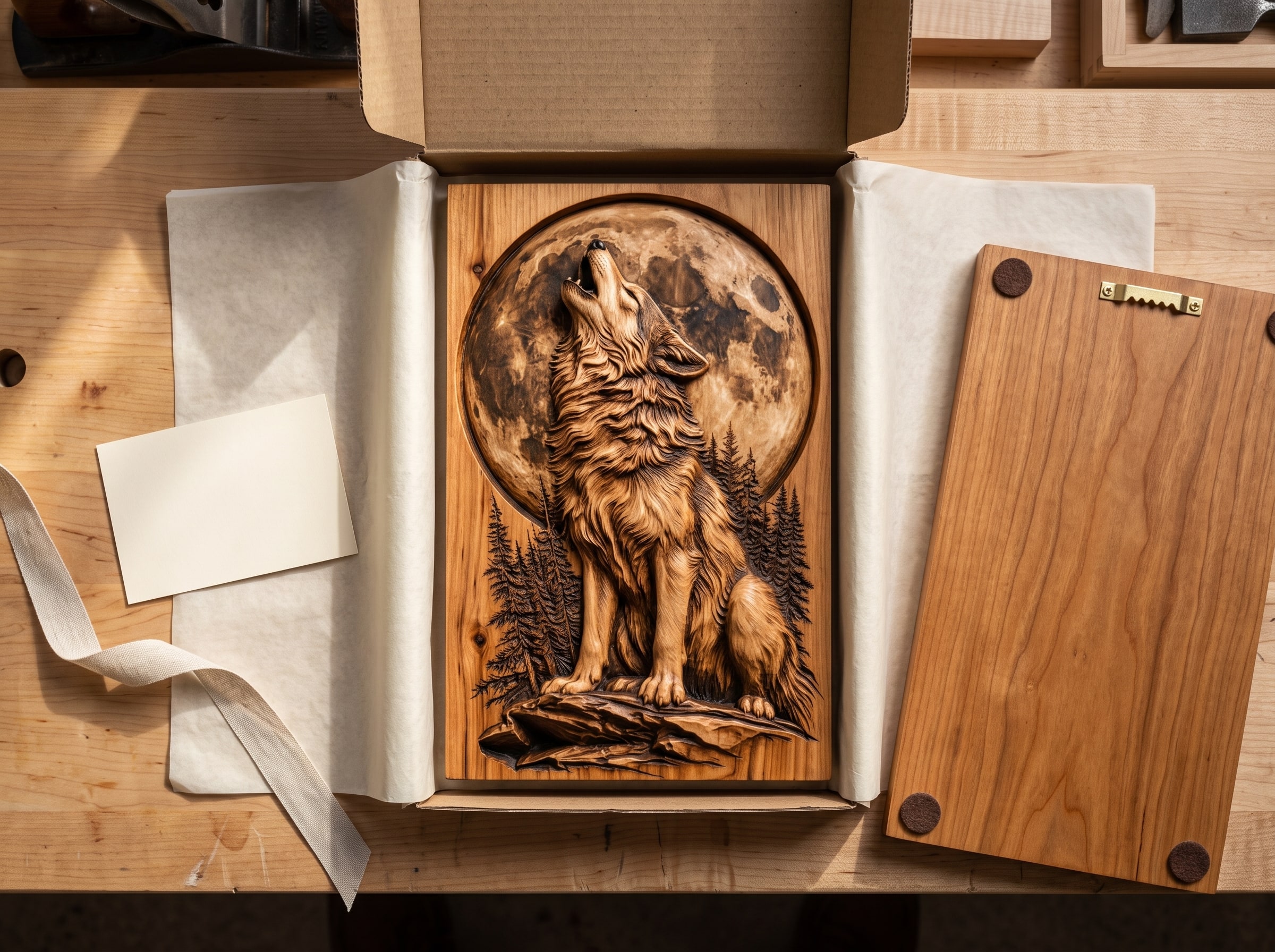
Tissue, a kraft box, a card, and a hanger already fitted on an oiled back. The whole kit costs under three dollars a piece and adds fifty to the price people will pay.
Fit the hanger. A sawtooth hanger or a keyhole slot, fitted and level, with felt bumpers at the bottom corners. A carving that can go on the wall the evening it arrives gets photographed and shared; one that leans against a skirting board for a month does not.
Finish the back. A wipe of the same oil. It stops the panel cupping, and a buyer who turns it over and finds bare wood wonders what else was skipped.
Sign it. Initials and the year, small, burned or carved on the back. It is the difference between a product and a piece.
A plain kraft box with tissue. Nothing beats it, and it doubles as gift wrap, which matters, because most carvings are bought as gifts.
A card that explains it. Species, the design's name, the finish, and one line of care ("wipe with a dry cloth; re-oil once a year"). People value what they understand.
Where to sell
Craft fairs and markets are where most carvers make their first sales, and the best place to learn what people pick up and what they walk past. Bring a range of sizes so there is something at $60 and something at $350, a small easel for every piece, and a way to take cards. Expect to cover the table fee with the first sale and profit from the second.
Etsy and similar marketplaces reach buyers who will never visit a fair, and they take a slice of every sale, so build the fee into the price rather than absorbing it. Your photographs are the whole listing; the section above is not optional there. Shipping a 400 mm panel is not cheap; quote it honestly rather than hiding it in the price.
Your own site keeps the whole price and is worth it once you have a following, not before.
Local often outperforms all of the above: a cabin rental company, a hunting lodge, a church gift shop, a fishing tackle shop, a coffee shop with an empty wall. One piece on consignment with a card and a price leads to commissions, and commissions are the best margin in this business.
Mistakes that cost sellers money
Pricing from the board. The board is the cheapest part of the piece.
Selling unfinished work. A raw carving looks flat and sells for a third of a finished one. Finish it; the glaze step alone doubles what people will pay.
Carving in pine to save money. It tears, it stripes, and buyers can tell. Cherry costs $15 more and sells for $100 more.
Only large pieces. A $60 heart panel pays the fair fee and puts your card in a bag; the $350 buck is what they come back for.
Photographs from the front. See above. It is the single most common reason a good carving does not sell online.
Promising a custom photo-to-relief of somebody's dog before you have carved one. Carve designed files first, learn what your machine can do, then take commissions.
If you are choosing what to carve first for a table, the two below are the best sellers in their categories and the safest bets we know.
Yes, in any quantity, with no royalties. What you cannot do is sell or share the file itself.
How much should I charge for a CNC carving?
Materials plus machine time plus your time, doubled, rounded up. For a 400 mm wildlife panel in cherry that lands around $295; in walnut, around $345.
What CNC carvings sell best?
Wildlife scenes, faith pieces, serving trays, fishing, and pet memorials, in that order, in our sales data.
Should I sell on Etsy or at fairs?
Start at fairs to learn what people pick up, then list the winners online with side-lit photographs. Local consignment often beats both.
Do I need to credit the designer?
No. Attribution is welcome but not required for the physical pieces you sell.
Can I modify a design before carving it?
Yes. Scale it, crop it, add a name, combine it with lettering. The result is still yours to sell; the file is still not.
Price it as work, finish it properly, light it from the side, and put it where the right people walk past. Most of the carvers who write to say they have quit their day job did those four things and nothing cleverer.
Jolly, DigitalChiselCo
🎁
Wait — take 5 free STL files
Our 5 best-selling bas-relief designs, free. CNC-tested, commercial use included.