Of everything a family brings out at Christmas, the nativity is the piece that matters most and changes least. Lights get replaced, ornaments break, but the manger scene goes back on the same shelf every year and gets handed down. Carved in solid wood, it becomes exactly that kind of heirloom, and relief carving suits it beautifully: a nativity has always been a framed tableau, a stable with the Holy Family inside it, which is just what a relief panel is.
This guide is about carving one well on a CNC router: choosing the scene, sizing it so the faces survive, the wood and the finish that make it look like it came from an old church, and a few designs that go with it, from a single ornament to a full Advent set.

In this guide
- Choosing the scene
- Size it for the faces
- The wood
- Carving it: roughing, a fine finish where it counts
- Open windows and pierced designs
- Finishing: natural, antiqued, painted or gilded
- An Advent set, one piece at a time
- Gifts, churches and bazaars
- Questions people ask
Choosing the scene
There is more than one way to carve the nativity, and the right one depends on where it will live.
The Holy Family and the cross. Two of the most loved designs tie Christmas to Easter in one piece. The Holy Family Nativity Scene CNC Relief STL stands Mary, Joseph and the young Jesus inside a cross, under the star, in a hand-carved frame: the one for the mantel or the hallway. The Holy Family Nativity Scene CNC Relief STL has Mary and Joseph kneeling beneath a cross with an open star window. If you want the stable itself, with the Child in the manger under the roof, it is there as the Holy Family Nativity Christmas Ornament CNC Relief STL, which also carves beautifully at panel size.
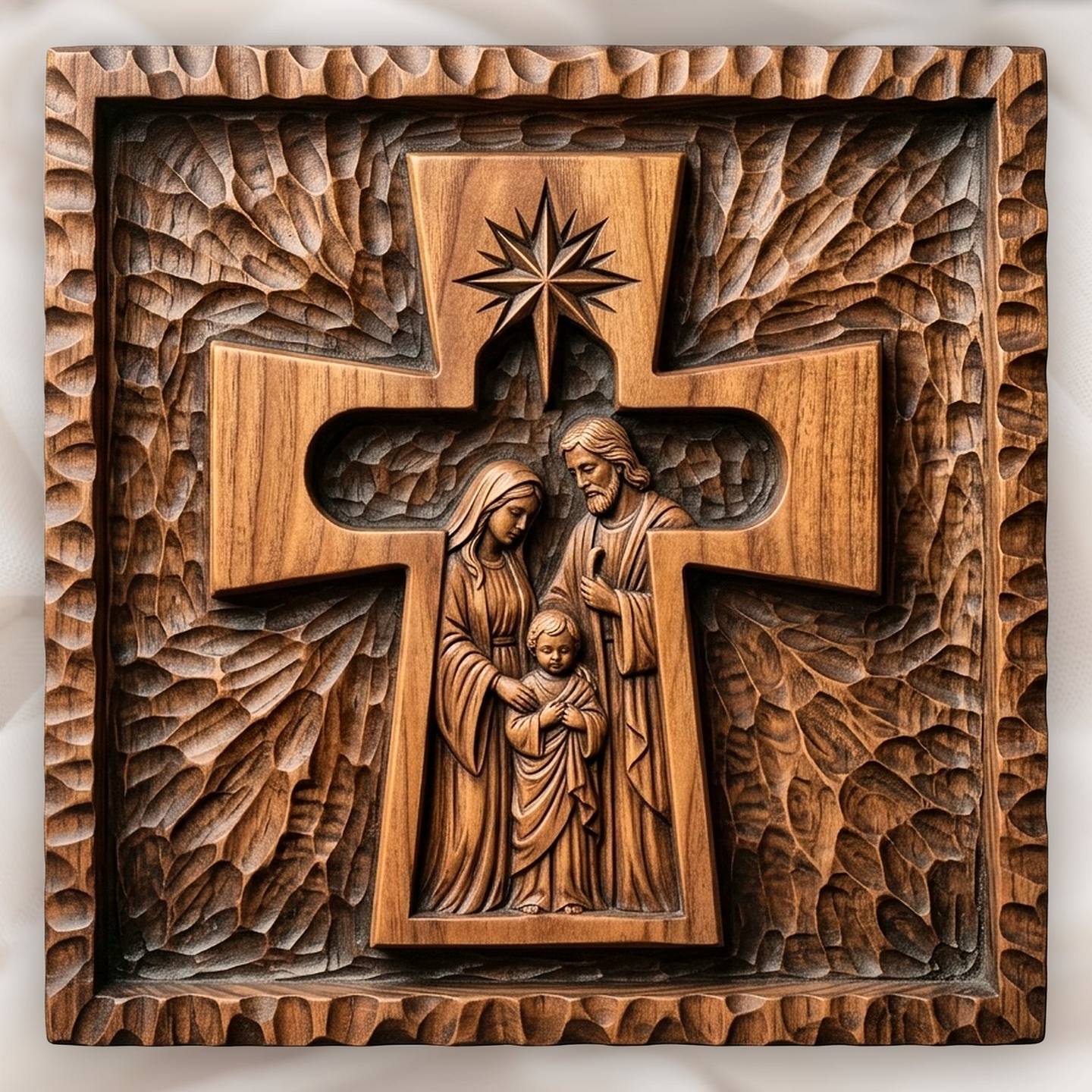
Get the Holy Family Nativity Scene · $10.00
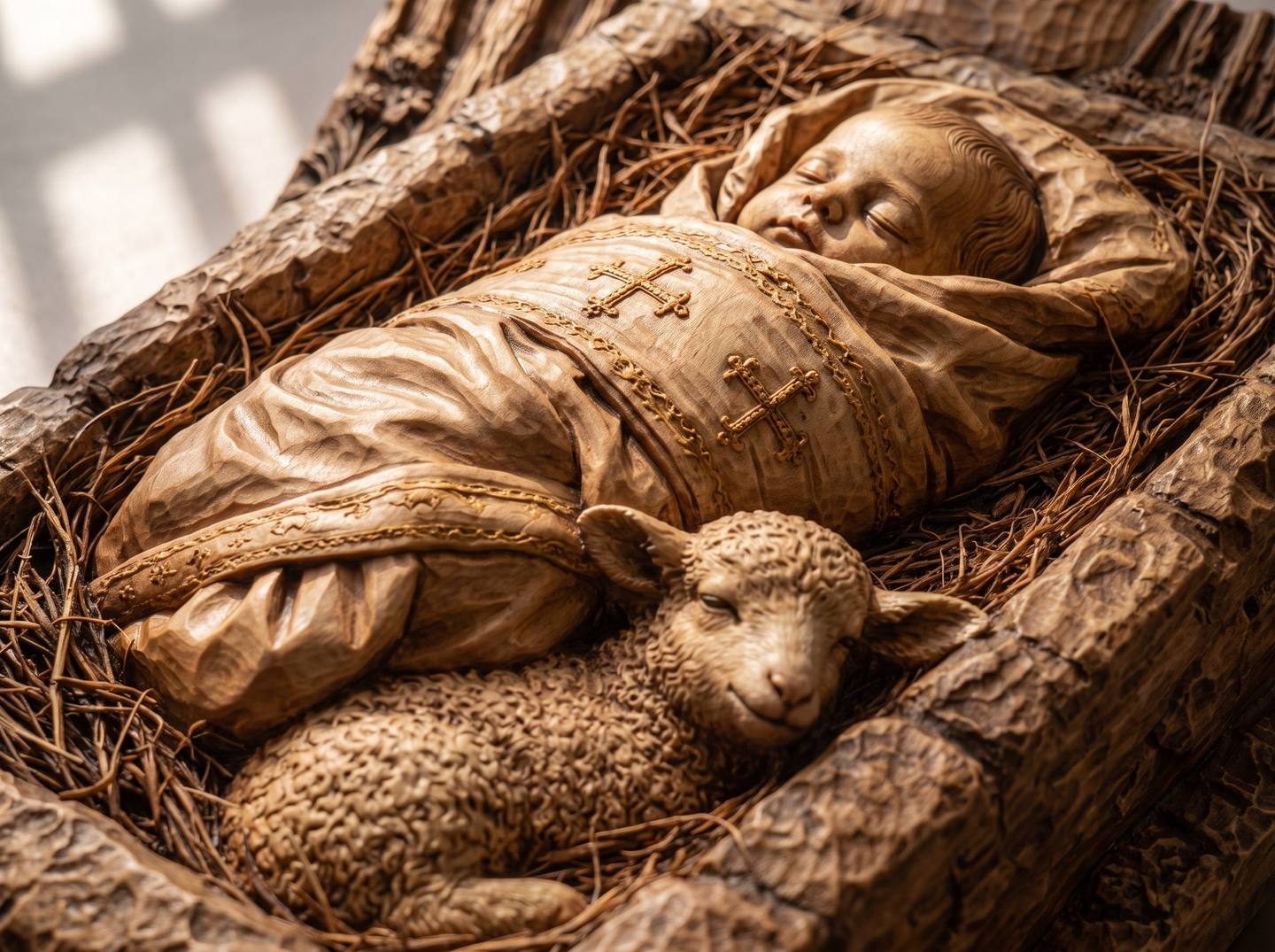
The manger alone. Sometimes less says more. The Sleeping Baby Jesus with Lamb in the Manger Relief STL shows only the sleeping Child with a lamb curled against him, and the Sacred Nativity Manger Scene with Lambs CNC Relief STL keeps the manger and the flock with the light falling on the straw. Both are intimate, small enough for a bedside table, and as fitting for a baptism as for Christmas.
A Celtic nativity. The Celtic Nativity Scene Christian Christmas CNC Relief STL sets the Holy Family inside a ring of Celtic knotwork. It suits a family with Irish or Scottish roots, and the knotwork frame means it needs no separate frame at all.
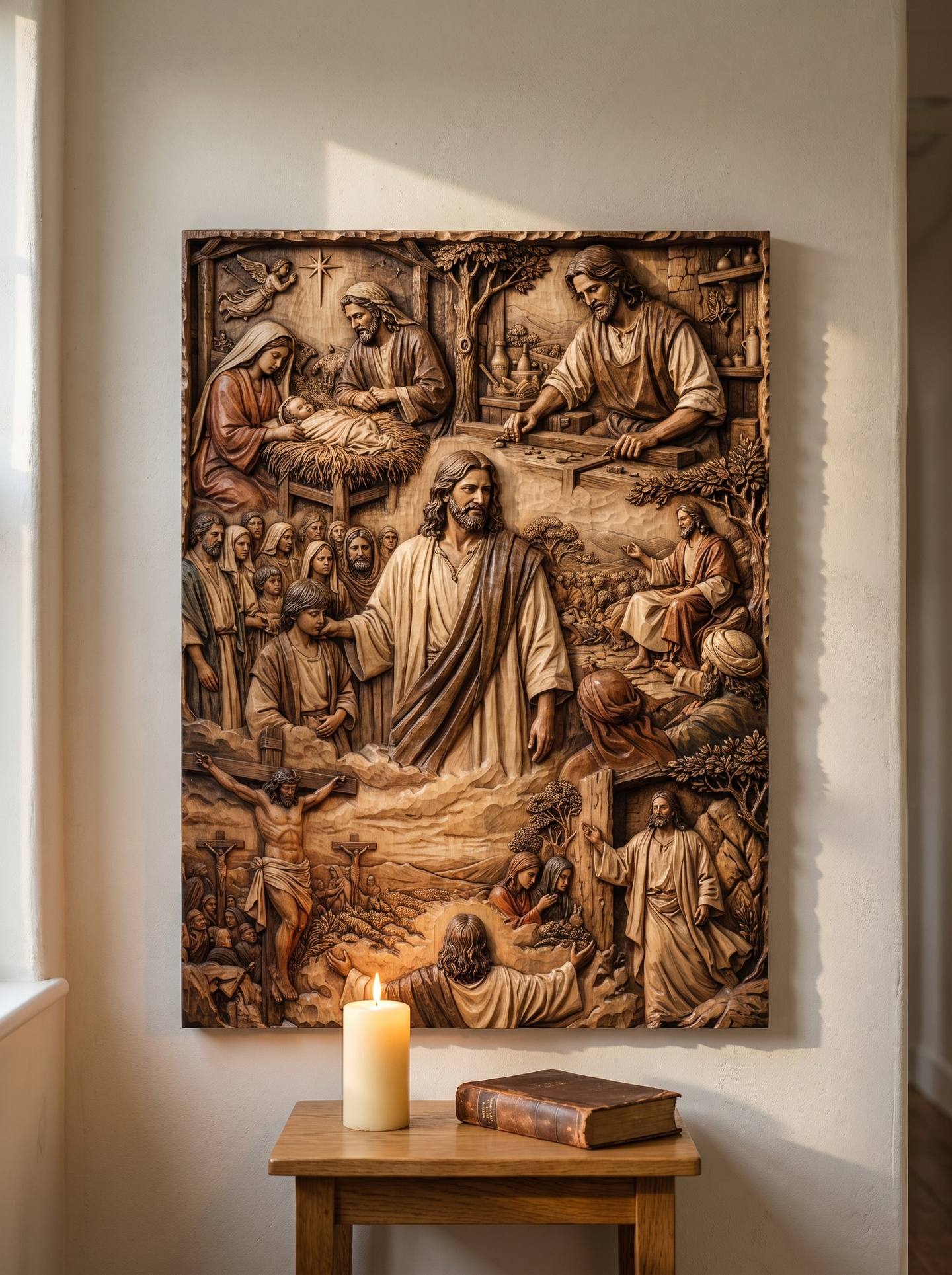
The whole story. The Life of Jesus Bas-Relief STL: Nativity to Crucifixion Panel runs from the birth in the stable to the cross in a single tall panel. It is the best seller of our nativity designs and the one people choose for a church wall or a gift for a pastor.
Size it for the faces
The faces decide the size. A nativity is a group of small figures, and if the faces come out too small, no bit and no stepover will give them features. As a working rule, aim for the smallest face in the scene to be at least an inch tall when carved. For most of these designs that means a panel of 10 to 14 inches on its long side for a mantel or wall piece. The manger designs, with one large figure, still look lovely at 7 or 8 inches.
Give a panel of that size 6 to 10 mm of relief depth on stock of 3/4 to 1 inch. Deeper than that and the figures start to look stuck on rather than carved in. Our guide to scaling STL files shows how to set both the size and the depth when you import.
The wood
- Walnut: the nativity wood. Deep brown, fine enough for faces, and it looks centuries old the moment it is oiled.
- Cherry: warmer and lighter, and it darkens beautifully over the years it spends on the mantel.
- Hard maple or basswood: the choice if you plan to paint. Maple holds the finest detail; basswood is softer and easier to paint but a little fuzzier.
Avoid open-grained oak for small faces: its pores run straight across a nose or a cheek. There is a side-by-side of eight species in our best wood for relief carving guide.
Carving it: roughing, a fine finish where it counts
A nativity is the textbook case for spending your finishing time where it matters and nowhere else.
- Rough the whole panel with a 1/4 inch or 1/8 inch ball nose to take out the bulk.
- Finish the panel with a 1/8 inch ball nose at around 10 percent stepover. The stable, the straw and the background are happy at that.
- Finish the figures with a 1/16 inch tapered ball nose at 8 percent, inside a boundary drawn around the faces and hands only. That is where the hours go, so keep the boundary tight.
On a hobby machine that method turns what could be a two-day carve into a long afternoon. Our guide to cutting relief carving time explains the boundary trick in detail, and Will it cut? estimates the time for your file, size and bits.
Open windows and pierced designs
Some designs have openings that go right through, like the star window in the cross of the Holy Family Nativity Scene CNC Relief STL. Carve the relief first, then cut the opening with an end mill and a profile toolpath, in several shallow passes so the thin wood around it does not break. If you would rather not cut through, pocket the opening deep instead and paint the bottom black: from across the room it reads as an opening. Either way, a light shining from behind a cut-through star on the mantel is one of the loveliest effects a carving can have.
Finishing: natural, antiqued, painted or gilded
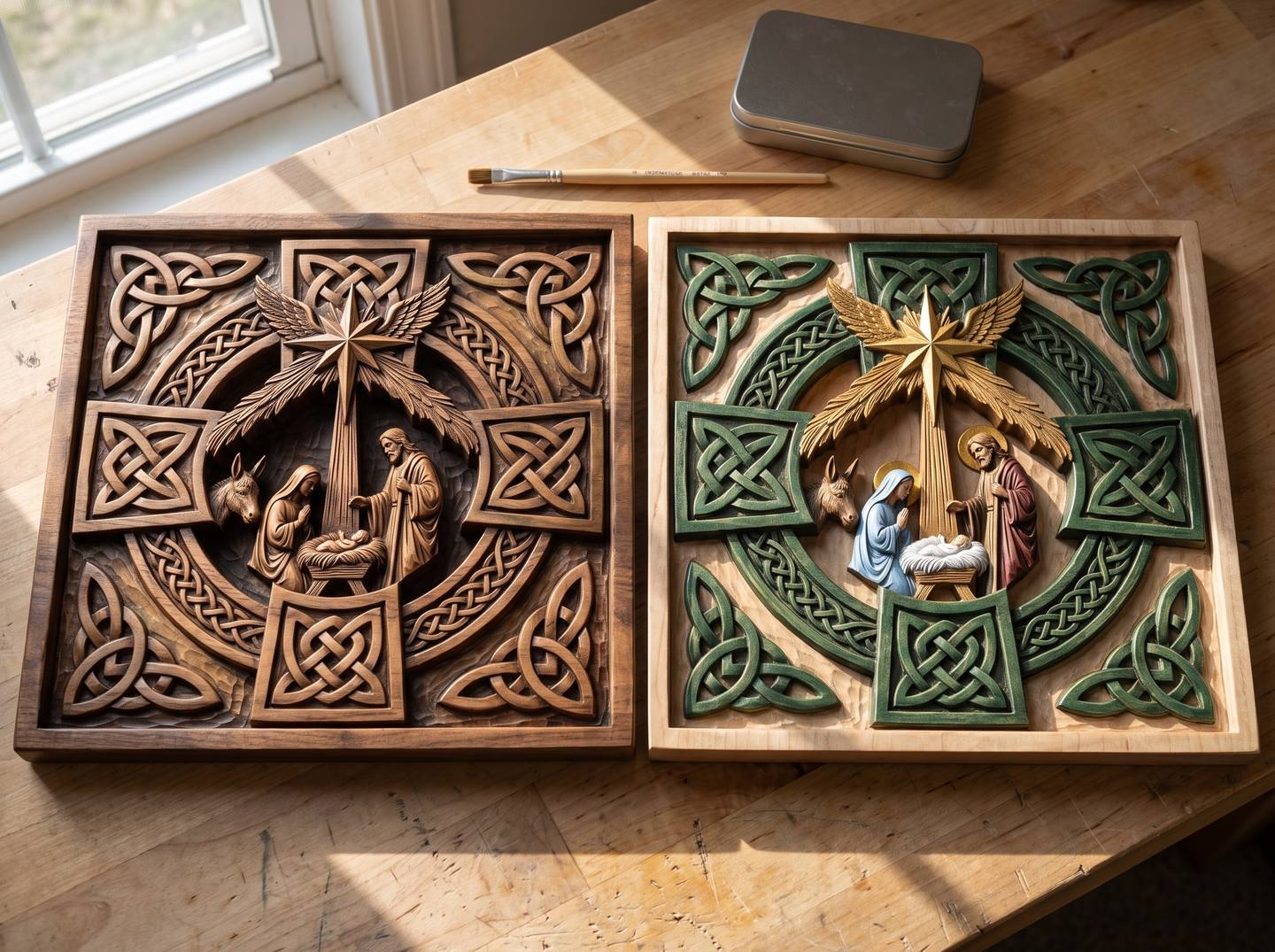
Brush the fuzz out of the detail first with a brass or stiff nylon brush. Then choose:
- Natural: two coats of Danish oil on walnut or cherry. Simple and timeless.
- Antiqued: after the oil has dried, brush a dark glaze into the carving and wipe it off the high points. The figures step forward from the stable and the panel looks like it came out of an old church.
- Painted: seal first, then acrylics in the traditional colours: blue for Mary's mantle, brown and red for Joseph, white for the swaddling, gold for the star and the halos. Dry-brush a lighter shade over the raised folds. Our guide to colouring a relief carving covers the method step by step.
- Gilded: imitation gold leaf on the star and the halos only, on otherwise natural wood. Of all the finishes, this is the one that stops people in the doorway.
More on oils, glazes and sealing in how to finish a CNC relief carving.
An Advent set, one piece at a time
The nativity does not have to arrive all at once. Advent starts on 29 November this year, and a family can build the story over the four weeks to Christmas:
- First week: the Journey to Bethlehem Mary CNC Relief STL, Mary on the road with the donkey.
- Second and third weeks: the Star of Bethlehem Ornament CNC Relief STL and the Holy Family Nativity Christmas Ornament CNC Relief STL for the tree.
- Christmas Eve: the Holy Family scene on the mantel, and the manger with the Child.

And for the front door, the Nativity Three Wise Men Doorbell Backing Plate CNC Relief STL greets every visitor with the Magi. If you want the lot, the Christmas & Nativity CNC Relief STL bundle gathers sixteen traditional Christmas and nativity designs at a bundle price.
Get the 16-piece Christmas & Nativity bundle · $50.69
Gifts, churches and bazaars
A carved nativity is one of the few gifts nobody already has. It is also the kind of piece churches ask for: for a parish hall, a retiring pastor, or the Christmas bazaar. Smaller pieces like the manger and the nativity ornament sell well at church fairs, and a name and a date on the back of a manger panel makes a baptism gift that is kept for a lifetime.
Every design includes commercial use, so you can carve and sell as many as you like. Our guide to selling CNC relief carvings covers pricing and where to sell, and the Christmas ornaments guide covers the small pieces to sell alongside them. No machine? A Cut Local maker near you can carve your nativity for you.
Questions people ask
What size should a carved nativity scene be?
Big enough that the smallest face is at least an inch tall: usually 10 to 14 inches on the long side for a full Holy Family scene, 7 or 8 inches for a manger.
What is the best wood for a nativity carving?
Walnut for a natural finish, cherry for a warmer one, hard maple or basswood if you plan to paint it.
How long does it take to carve?
A 12 inch Holy Family scene is usually an afternoon to a day on a hobby machine with a roughing pass and a fine bit only on the faces. Will it cut? gives a time for your exact file.
Can I sell the nativity scenes I carve from these files?
Yes. Commercial use is included with every design. You can sell the carvings, but not the file itself.
Can I 3D print a nativity relief instead?
Yes. The STL prints flat with no supports, and paints beautifully. Our guide to 3D printing a bas-relief STL has the settings.
Carve it once and it comes out every December for the next fifty years. Start with the manger if you have never carved a face, and the Holy Family scene when you are ready. The full Christian collection has hundreds more, and the Christmas collection the rest of the season.
Jolly, DigitalChiselCo